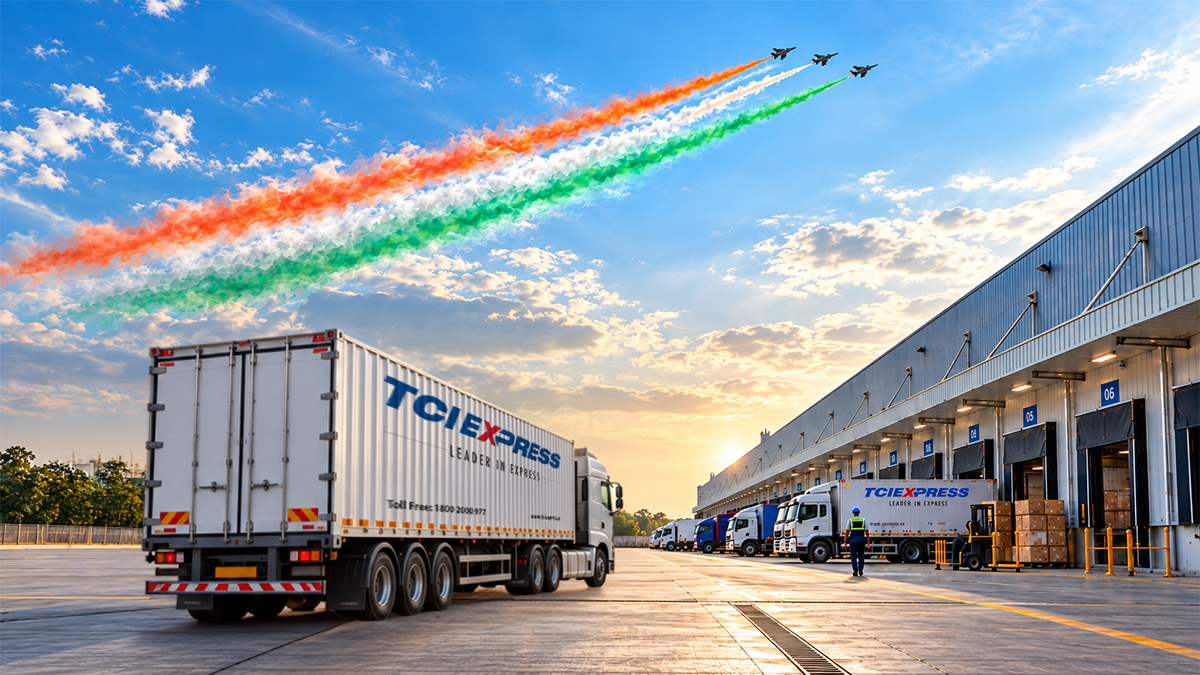
Indian Air Force Day 2026: TCI EXPRESS Salutes the Guardians of India’s Skies
Key Takeaway
- Indian Air Force Day 2026
- 94 Years of Vigilance & Valour: On 8 October 2026, India commemorates the 94th Indian Air Force Day, honouring nine decades of courage, discipline, and strategic defence since the founding of the force in 1932.
- Beyond Air Defence to Humanitarian Mission: Recognizing the Indian Air Force's vital role in national disaster relief, emergency medical evacuations, and lifeline supply airlifts during natural calamities.
- Operational Lessons for Industry: Highlighting core principles of military readiness—rigorous advance preparation, clear chain-of-command accountability, precision data, and active contingency planning—that inspire civilian supply chain resilience.
- TCI EXPRESS Tribute & Service Discipline: Saluting serving personnel, veterans, and air warrior families while reflecting military dedication in commercial logistics through speed, reliability, and round-the-clock national connectivity.
Indian Air Force Day 2026 is an occasion to honour the courage, discipline and service of the air warriors who protect India’s skies. Observed on 8 October, the day marks the establishment of the Indian Air Force in 1932 and reminds the nation of the people whose preparation, skill and commitment support its security.
On this important day, TCI EXPRESS pays respectful tribute to serving personnel, veterans, civilian personnel and the families who support them. Their contribution is measured not only in aircraft, missions or ceremonial displays, but also in the vigilance, teamwork and readiness maintained every day.
While the Indian Air Force guards the nation’s airspace, TCI EXPRESS works in a very different civilian role to help businesses move cargo across India. These responsibilities should not be equated. Military service involves a level of duty, sacrifice and national responsibility that stands apart. Our message is simply one of gratitude and respect, along with recognition of the universal value of discipline, preparation and service.
What is Indian Air Force Day 2026?
Indian Air Force Day is observed every year on 8 October. According to the Government of India’s official account of the service’s history, the Indian Air Force was established on 8 October 1932. Its first operational flight was formed on 1 April 1933 with six officers trained by the Royal Air Force, 19 Havai Sepoys and four Westland Wapiti IIA aircraft.
The official observance in 2025 marked the Indian Air Force’s 93rd anniversary. Therefore, 8 October 2026 marks its 94th anniversary. It is a day to look back at more than nine decades of institutional growth while also recognising the people, technology, training and operational readiness that shape the force today.
For citizens searching for the meaning of Indian Air Force Day, the answer is straightforward: it commemorates the founding of the service and honours its contribution to national defence, humanitarian support and public service.
Why is Indian Air Force Day celebrated on 8 October?
The date comes directly from the founding history of the Indian Air Force. It was officially established on 8 October 1932. India was still under colonial rule at the time, and the service later carried the prefix “Royal”. After India became a republic, that prefix was dropped in 1950 and the service became known as the Indian Air Force.
The annual observance connects this history with the present. Ceremonial activities, professional engagements and public messages create an opportunity to understand the service’s evolution and to thank the people who sustain it. The occasion is not only about visible displays of air power. It is also about the less visible work behind readiness: maintenance, training, planning, engineering, communication, logistics, medical support, administration and coordinated decision-making.
From a small beginning to 94 years of service
The Indian Air Force began with limited personnel and aircraft, yet it developed over successive decades into a major national institution. Its history includes participation in India’s wars, protection of national airspace, support to civil authorities, evacuation missions and humanitarian assistance during emergencies.
This long journey illustrates why strong institutions depend on more than equipment alone. Aircraft capability matters, but so do trained people, reliable systems, clear command structures, technical maintenance, accurate information and the ability to respond when conditions change. Readiness is created through repeated preparation before a mission begins.
In 2026, the Indian Air Force also hosted Exercise Tarang Shakti from 26 September to 12 October under the theme “Power in Partnership”. The Government of India described participation by seven friendly foreign countries. This current example shows how professional cooperation, interoperability and shared learning form part of modern air-force engagement.
What does the nation honour on Indian Air Force Day?
The day honours many connected qualities and contributions.
Courage in the service of the country
Air operations can require difficult decisions under demanding conditions. Courage includes the willingness to accept responsibility, remain focused and act with professional judgement when the stakes are high.
Discipline behind every mission
A successful mission is supported by procedures that must be understood and followed. Discipline applies across flight operations, engineering, ground support, safety, communication and command. It turns individual skill into coordinated capability.
Precision supported by preparation
Precision is not achieved at the final moment alone. It begins with planning, training, inspection, accurate data and clearly assigned responsibilities. Each stage supports the next, and every team member contributes to the required outcome.
Readiness for changing conditions
Weather, terrain, equipment status and operating circumstances can change quickly. Readiness requires alternatives, timely information and teams that know when and how to respond. It is built over time through exercises, review and continuous improvement.
The support of families
Service personnel do not carry their responsibilities alone. Families often live with long separations, transfers, uncertainty and the demands of service life. Indian Air Force Day is also an appropriate moment to acknowledge their patience and strength.
Protecting the skies and helping people during emergencies
The Indian Air Force’s contribution extends beyond its central responsibility for air defence. Official government accounts also recognise its role in humanitarian assistance, disaster relief and evacuation. During severe natural disasters or other emergencies, air capability can help reach areas that are difficult to access by road, move relief material, evacuate affected people and support civil authorities.
These operations depend on coordination among aircrew, technical teams, ground staff, government authorities and relief agencies. The public may see an aircraft arriving with supplies or carrying evacuees, but every movement is supported by planning, assessment, loading, documentation, communication and safety checks.
This wider service to the nation helps explain why Indian Air Force Day is meaningful even for people who have no direct connection with the armed forces. The institution protects national interests and, when called upon, assists communities in moments of urgent need.
Indian Air Force Day 2026 and the meaning of Nation First
“Nation First” is more than a ceremonial expression. In public service, it means placing duty, integrity and collective responsibility above personal convenience. It also asks citizens and organisations to consider how their own conduct can contribute to a stronger country.
For a business, responsible conduct may include following the law, protecting employee welfare, maintaining honest customer communication, supporting communities and improving the reliability of its operations. These are civilian responsibilities, not military ones, but they matter to the wider economic and social system.
A strong India depends on many institutions performing their distinct roles well. The armed forces protect national security. Public institutions provide essential administration and services. Businesses create employment, serve customers and support economic activity. Citizens contribute through their work, choices and participation in society.
Lessons in preparedness for Indian businesses
The armed forces operate in a context that cannot be compared directly with commercial logistics. However, businesses can still reflect on broad organisational principles such as preparation, teamwork and accountability. These principles are useful in any environment where people must coordinate complex work.
Prepare before urgency arrives
Organisations should identify operational risks before they become disruptions. For a shipper, this can mean confirming service availability, preparing documents, using suitable packaging and sharing accurate shipment information before dispatch. Businesses can check destination coverage through the TCI EXPRESS pin-code enquiry and discuss shipment-specific requirements through the company’s official contact channels.
Make responsibilities clear
Complex work becomes harder when ownership is uncertain. A business shipment should have clear sender and receiver contacts, approved documentation, a defined delivery requirement and an agreed process for exceptions. Teams should know who can make a decision when circumstances change.
Use accurate information
Incorrect dimensions, addresses, contact details or commodity descriptions can disrupt planning. Accurate information supports service selection, routing, handling and customer communication. Once dispatched, customers can use the TCI EXPRESS shipment tracking facility to follow available shipment updates.
Build alternatives into the plan
A single route or mode may not suit every requirement. Depending on the commodity, destination, urgency and service availability, businesses may assess options such as Surface Express, Domestic Air Express or Rail Express. The appropriate option should be confirmed for the actual consignment rather than assumed from a general description.
Review outcomes and keep learning
After an important project, campaign or shipment cycle, teams should review what happened. Useful questions include whether the original information was accurate, where delays occurred, how exceptions were handled and what should change next time. Continuous learning makes future preparation stronger.
How TCI EXPRESS supports movement on the ground
TCI EXPRESS serves businesses through a portfolio of express logistics services. The company’s role is commercial: collecting, processing, moving and delivering accepted consignments according to the selected service and agreed conditions.
A dependable shipment journey requires coordination across several stages:
- Understanding the customer’s shipment requirement
- Confirming destination and service availability
- Receiving accurate commodity, package and contact information
- Selecting an appropriate service and operating plan
- Processing shipments through the network
- Providing tracking visibility through available systems
- Managing delivery and recording proof of delivery
- Escalating exceptions through the appropriate support channels
Businesses can learn more about the company’s network and operating capabilities on the TCI EXPRESS infrastructure page, explore the wider express services portfolio, and consult published annual reports for formal corporate information.
An operational perspective: Time-critical air logistics, precision networks and 24/7 readiness
While commercial logistics operates in a distinct civilian sphere, delivering time-critical express cargo across India requires an uncompromising focus on precision, speed, and continuous monitoring—principles exemplified by air operations:
- Domestic Air Express Corridors: TCI EXPRESS leverages dedicated commercial airline space allocations across all major domestic airports, offering next-day and 24-to-48-hour delivery windows for mission-critical cargo, including aircraft-on-ground (AOG) spares, engineering parts, life-saving pharmaceuticals, and high-value electronics.
- 24/7 Centralized Control Tower Governance: Every air freight movement is tracked end-to-end through a centralized Control Tower. Operations teams maintain real-time visibility over flight departures, airport tarmac transfers, and regional cut-off schedules, enabling proactive mitigation when flight delays or adverse weather occur.
- Multi-Modal Contingency Routing: When airspace is restricted or scheduled flights experience severe weather disruptions, TCI EXPRESS’s integrated multi-modal network can dynamically divert urgent consignments onto fast-tracked Surface Express or dedicated charter routes, ensuring supply chain continuity.
- Tamper-Evident Security and Digital ePOD: Precision handling demands strict chain of custody. Consignments are secured using tamper-evident barcode seals, barcode scans at each touchpoint, and instant electronic Proof of Delivery (ePOD) to maintain verifiable audit trails from origin to delivery.
By treating timing, reliability, and communication as disciplined operational standards, commercial express services support the nation’s economic pulse every day.
A respectful salute from TCI EXPRESS
Indian Air Force Day belongs first to the air warriors and the institution they serve. It is a time to recognise those on operational duty, those who maintain aircraft and systems, those who train the next generation, veterans whose service shaped the force, civilian personnel who support its work and families who stand beside them.
TCI EXPRESS joins the nation in expressing sincere gratitude to the Indian Air Force for its dedication to protecting India’s borders and airspace. We honour its history, respect its service and wish strength and success to everyone who carries this responsibility forward.
Happy Indian Air Force Day.

Frequently Asked Questions
When is Indian Air Force Day celebrated?
Indian Air Force Day is celebrated every year on 8 October.
Why is Indian Air Force Day observed on 8 October?
The date marks the official establishment of the Indian Air Force on 8 October 1932.
Which anniversary is Indian Air Force Day 2026?
Indian Air Force Day 2026 marks the service's 94th anniversary, following the 93rd anniversary officially observed by the Government of India in 2025.
What is the significance of Indian Air Force Day?
The day commemorates the founding of the Indian Air Force and honours the service, courage, discipline, and sacrifices of its air warriors in safeguarding India's skies.
Does the Indian Air Force support disaster-relief operations?
Yes. In addition to air defence, the Indian Air Force plays a pivotal role in humanitarian assistance and disaster relief (HADR), conducting search-and-rescue, casualty evacuation, and airlifting essential supplies during natural calamities.
How do military operational principles apply to express logistics?
Express logistics adopts foundational operational disciplines such as rigorous advance planning, clear accountability, real-time data tracking, and dynamic contingency routing to ensure resilient transit during disruptions.
What is TCI EXPRESS’s tribute for Indian Air Force Day 2026?
TCI EXPRESS salutes all serving air warriors, veterans, civilian personnel, and their families for their unwavering dedication and vigilance in protecting India’s borders and airspace.
References & Sources
- TCI EXPRESS official Indian Air Force Day 2026 tribute: LinkedIn post, published 8 October 2026 ↗
- Press Information Bureau: Indian Air Force Day History and Organisation ↗
- Press Information Bureau: Birth of the Indian Air Force ↗
- Press Information Bureau: 93rd Indian Air Force Anniversary in 2025 ↗
- Press Information Bureau: Indian Air Force Humanitarian Assistance and Disaster Relief ↗
- Press Information Bureau: Exercise Tarang Shakti 2026 Multilateral Engagement ↗
- TCI EXPRESS Domestic Air Express Services ↗
- TCI EXPRESS Infrastructure and Multi-Modal Network ↗