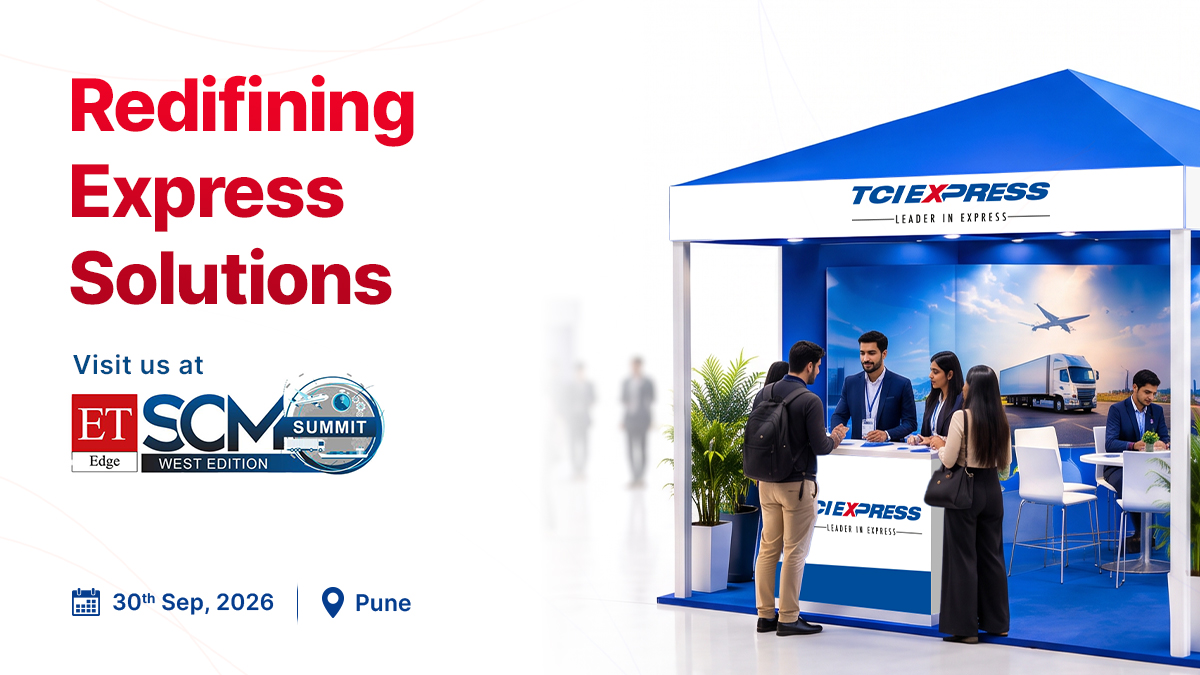
Meet TCI EXPRESS at the ET Edge SCM Summit in Pune
Key Takeaway
- Western India Logistics Crossroads: TCI EXPRESS is participating in the ET Edge SCM Summit West Edition in Pune on 30 September 2026, engaging with supply-chain leaders across automotive, engineering, and manufacturing sectors.
- Practical Lane-Specific Consultations: Enterprise decision-makers can visit the TCI EXPRESS booth to discuss dispatch optimization, multimodal route selection, and reducing end-to-end turnaround times.
- Beyond Freight Rates to Total Cost: Highlighting that true logistics value comes from predictability, automated sorting precision, and exception ownership rather than merely chasing low baseline freight rates.
- Direct Access to Infrastructure Solutions: Connect directly with express logistics experts to evaluate tailor-made Surface, Air, Rail, and C2C Express services backed by a nationwide automated network.
TCI EXPRESS is participating in the ET Edge SCM Summit West Edition in Pune on 30 September 2026. Supply-chain leaders, operations professionals, manufacturers and growing businesses are invited to visit the TCI EXPRESS booth and discuss how a well-planned express delivery network can support dispatch operations and improve end-to-end turnaround time.
The summit creates an opportunity to move beyond general logistics conversations. Visitors can bring real shipment questions, such as how to serve a new market, manage recurring dispatches, select an appropriate transport mode, improve shipment visibility or prepare for a seasonal increase in volume.
TCI EXPRESS looks forward to meeting supply-chain leaders in Pune, understanding their operating priorities and exploring practical logistics solutions aligned with their business needs.
About the ET Edge SCM Summit West Edition 2026
The official ET Edge event calendar lists the SCM Summit West Edition 2026 in Pune on 30 September. The summit is designed as a forum for supply-chain leaders, enterprise decision-makers, logistics professionals and other stakeholders to discuss the priorities shaping Western India's manufacturing, trade and distribution ecosystem.
According to ET Edge's event communication, Western India continues to play an important role in manufacturing, logistics and economic growth. Pune is a natural location for this conversation because it connects a strong industrial base with automotive, engineering, technology, pharmaceutical and other business activity.
People interested in attending should use the organiser's SCM Summit West registration-interest page for the latest access and event information. Venue, entry, timing and delegate arrangements should be confirmed directly from the final organiser communication.
Why supply-chain conversations matter now
Supply chains are expected to support growth while remaining efficient, visible and resilient. A business may need to expand into more cities, respond to shorter customer lead times, handle a wider product range or manage demand that changes by season and location.
These requirements cannot be solved by transport capacity alone. Businesses need decisions to connect across forecasting, inventory, packaging, dispatch, documentation, transportation, tracking, delivery and exception management.
A useful supply-chain discussion should therefore begin with the business outcome. Is the company trying to reduce production downtime, improve distributor replenishment, reach a new regional market, protect an installation schedule or create a more predictable dispatch cycle? Once the outcome is clear, the shipment profile and operating plan can be assessed.
What visitors can discuss at the TCI EXPRESS booth
The TCI EXPRESS booth can be used as a starting point for a practical, lane-specific conversation. Visitors may wish to discuss the following areas.
Pan-India express delivery
Businesses that sell or distribute across several states need more than a national map. They need to know whether the exact origin and destination are serviceable, how frequently the lane operates and which service fits the cargo and delivery requirement.
TCI EXPRESS provides a portfolio of express logistics services supported by a nationwide network. Visitors can discuss how this network may support business movement from factory, warehouse or supplier locations to distributors, retailers, offices, service centres and other commercial destinations.
Dispatch planning
Dispatch performance is often affected before pickup begins. Orders may be released late, packages may not be ready by the collection cut-off or documents may not match the physical consignment. A discussion at the booth can help identify where information and responsibility should move more clearly between the shipper and logistics provider.
Turnaround-time improvement
Turnaround time should be measured across the complete journey, not only the time spent on the main transport leg. It can include order release, picking, packing, pickup readiness, origin processing, transit, destination processing, out-for-delivery activity and consignee receipt.
Visitors can explore how better shipment preparation, service selection, cut-off alignment and exception ownership may reduce avoidable waiting without creating unrealistic delivery promises.
Mode and service selection
Different shipments may need different operating models. Surface Express may suit broad door-to-door distribution. Domestic Air Express may be evaluated for urgent accepted cargo. Rail Express may be considered for suitable long-distance lanes, while C2C Express can support appropriate full-truck movements.
The right choice depends on origin, destination, cargo, package dimensions, weight, urgency, frequency, documentation and capacity. A service should not be selected only because it is faster or has a lower headline freight rate.
Shipment visibility
Customers need to understand where a shipment is and what will happen if a planned milestone does not occur. TCI EXPRESS provides a public shipment tracking facility, an electronic proof-of-delivery facility and account tools through its customer login, subject to the applicable service and account configuration.
At the booth, businesses can discuss which milestones matter most, who should receive exception information and what reporting may be available for recurring shipments.
How to prepare for a useful booth consultation
A short conversation becomes more valuable when the shipment requirement is specific. Visitors do not need to carry confidential commercial data, but a representative shipment or lane profile can help the team understand the operating need.
Useful information includes:
- Origin and destination cities or pin codes
- Commodity description and any handling restrictions
- Number of packages in a typical dispatch
- Actual weight and packed dimensions
- Daily, weekly or monthly shipment frequency
- Current pickup time and dispatch cut-off
- Required delivery outcome
- Present mode of transport
- Seasonal or month-end volume variation
- Tracking, reporting and proof-of-delivery requirements
- Common delay or exception reasons
Businesses can perform an initial destination check through the TCI EXPRESS pin-code enquiry and identify nearby operating contacts through the branch locator. Final serviceability and acceptance should be confirmed for the actual shipment.
What does dispatch optimisation really involve?
Dispatch optimisation does not simply mean sending every shipment earlier. It means reducing avoidable delay and variation while protecting the customer's required outcome.
Order release
The warehouse needs enough time to pick, verify, pack, label and document the order before the pickup cut-off. If orders are released in one late batch, even sufficient transport capacity may not prevent delay.
Package readiness
The final packed dimensions and weight should be available before booking. Packaging must suit the product and journey, and old routing labels should be removed or covered.
Document readiness
Invoices, bills of supply, delivery challans, e-way bills and commodity-specific documents should be prepared according to the transaction and applicable requirements. The responsible business and its advisers must determine the correct legal and tax treatment.
Pickup alignment
The shipper and logistics provider should agree on the collection window, expected package count and escalation contact. Recurring dispatches may benefit from a defined pickup plan rather than repeated last-minute requests.
Receiving readiness
The consignee's address, contact, business hours and unloading conditions should be confirmed before dispatch. A shipment can reach the destination city on time and still be delayed if the recipient is unavailable.
Understanding turnaround time from end to end
A complete turnaround-time review separates controllable stages instead of treating the total journey as one number. A business can measure:
- Time from order release to packing completion
- Time from pickup request to collection
- Origin processing time
- Main movement and connection time
- Destination processing time
- Time from destination arrival to delivery attempt
- Time from delivery to electronic proof-of-delivery availability
- Time required to close an exception
This approach helps identify whether the main opportunity lies in warehouse preparation, pickup scheduling, mode selection, route design, consignee coordination or exception response.
How network infrastructure supports express movement
Express delivery requires a connected operating system. Branches, vehicles, sorting centres, route schedules, technology and people must work together so that shipments move from origin to destination with clear custody and status information.
The TCI EXPRESS infrastructure overview describes its network of branches, containerised vehicles and automated sorting centres. The company's FY 2024–25 Annual Report provides further information about its network, operations and business strategy.
Infrastructure scale should always be translated into a practical lane plan. The availability of a broad network does not automatically confirm that every cargo type, pickup time or destination condition can be accepted. Shipment-specific confirmation remains important.
Important questions for supply-chain leaders
Visitors can use the summit discussion to test whether their current logistics process supports business growth. Useful questions include:
- Which lanes create the most delay or uncertainty?
- Are dispatch cut-offs aligned with warehouse order-release times?
- Which shipments require faster service because delay has a high business cost?
- Could regular lanes benefit from planned capacity and pickup schedules?
- Are package dimensions and chargeable weight captured correctly?
- Can customers and internal teams see the same shipment milestones?
- Who owns an exception at origin, in transit and at destination?
- How quickly is electronic proof of delivery available?
- Which remote or restricted lanes need advance confirmation?
- Can a representative lane be tested before a wider allocation?
From freight rate to total logistics cost
The lowest quoted freight rate is not always the lowest-cost operating choice. A business should consider the complete cost of movement and the consequences of delay.
A lane comparison may include:
- Base freight and applicable surcharges
- Pickup and final-delivery charges
- Packaging, loading and unloading
- Transfer or consolidation handling
- Inventory held because of transit variability
- Production downtime or missed-sales exposure
- Emergency replacement shipments
- Claims and exception-administration effort
- Tracking, reporting and integration effort
The most suitable plan is the one that protects the required business outcome at a supportable total cost. Summit conversations can help businesses frame this comparison more clearly.
Why Pune is important to the supply-chain conversation
Pune and the wider western region serve a diverse industrial ecosystem. Manufacturers, component suppliers, distributors, technology businesses and service organisations depend on timely movement between production centres, warehouses, customers and national markets.
This makes Pune a valuable meeting point for discussions about resilient supply chains, manufacturing growth, technology, multimodal connectivity and B2B logistics. The ET Edge SCM Summit allows participants to compare perspectives across industries rather than examining logistics in isolation.
An operational perspective: Automated hub capabilities powering Western India
For industrial enterprises across Maharashtra, Gujarat, and the broader western corridor, dispatch predictability is anchored by TCI EXPRESS's technologically advanced automated sorting centre in Pune. Designed to handle peak regional throughput with minimal human touchpoints, the facility integrates high-speed cross-belt sortation systems, automated dimension-weigh-scan (DWS) tunnels, and direct containerised dock-to-linehaul connectivity.
By processing consignments through high-velocity optical barcode scanners and dynamic lane divert algorithms, the Pune hub significantly shortens sorting cycles and minimizes dwell time. For summit attendees managing critical automotive assemblies, precision engineering parts, electronics, or healthcare products, this infrastructure translates into faster inter-state connections, reduced transit variability, and verified electronic proof-of-delivery (ePOD) within hours of destination arrival.
Visit the TCI EXPRESS booth
TCI EXPRESS welcomes supply-chain leaders, procurement teams, operations professionals, warehouse managers, manufacturers, distributors and growing enterprises to visit its booth at the ET Edge SCM Summit West Edition in Pune on 30 September 2026.
Bring a representative lane, a recurring dispatch problem or a growth plan. The conversation can begin with the shipment profile and focus on the practical decisions that influence pickup, processing, mode selection, visibility, delivery and exception handling.
Visitors who cannot attend can use the TCI EXPRESS business enquiry form to share their logistics requirements. Current customers can also use the published TCI EXPRESS contact channels for appropriate support.
We look forward to connecting with supply-chain leaders in Pune and exploring how disciplined express logistics can support faster, more predictable business movement.
Frequently Asked Questions
When is the ET Edge SCM Summit West Edition 2026?
The summit is scheduled for 30 September 2026 in Pune. Attendees should confirm current timing, venue and entry information through the official organiser communication.
Is TCI EXPRESS participating in the Pune SCM Summit?
Yes. TCI EXPRESS has officially announced its participation and invited supply-chain leaders to visit its booth.
What can visitors discuss with TCI EXPRESS at the summit?
Visitors can discuss pan-India express delivery, dispatch planning, service selection, shipment visibility, turnaround time, recurring lanes and exception-management requirements.
What information should a business bring to the booth?
Useful information includes origin and destination pin codes, commodity, package count, weight, dimensions, frequency, current transit experience, delivery requirement and common exceptions.
How can a business check TCI EXPRESS serviceability?
A business can begin with the TCI EXPRESS pin-code enquiry and branch locator. Final lane and shipment acceptance still require confirmation.
How can someone contact TCI EXPRESS after the summit?
Businesses can submit their requirement through the TCI EXPRESS business enquiry form or use the company's published contact channels.