TCI EXPRESS at the ET Pharma Supply Chain Summit 2026: Building More Visible and Controlled Cold Chains
Key Takeaway
- Healthcare Quality Beyond Manufacturing: TCI EXPRESS participated in the 4th ET Pharma Supply Chain Summit 2026 in Hyderabad, demonstrating how GDP-compliant temperature controls protect pharmaceutical efficacy from lab to patient.
- Sensor-Monitored Cold Chain Infrastructure: Showcased real-time IoT temperature logging, calibrated multi-zone refrigerated vehicles, and active excursion notification systems across vital healthcare lanes.
- Comprehensive GDP Governance: Emphasized that genuine Good Distribution Practices require end-to-end standard operating procedures, vehicle qualification, trained handling crews, and verifiable audit trails.
- Rigorous Excursion & Deviation Ownership: Outlining structured protocols where real-time sensor alarms trigger immediate containment, evidentiary data preservation, and collaborative quality review with pharmaceutical manufacturers.
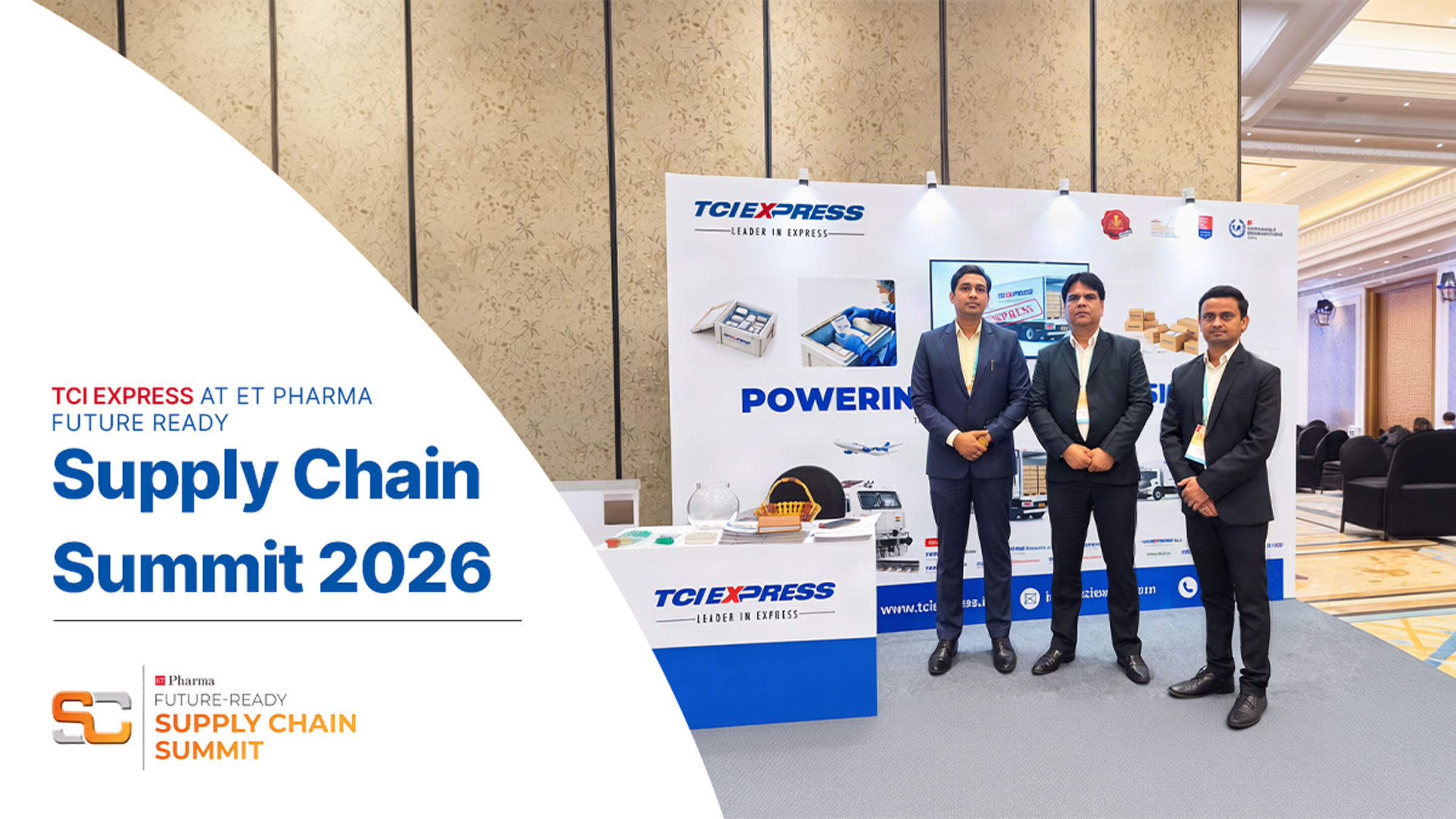
TCI EXPRESS participated in the ET Pharma Supply Chain Summit 2026 in Hyderabad, engaging with pharmaceutical leaders and showcasing its sensor-monitored, GDP-certified cold-chain infrastructure. The event gave the TCI EXPRESS team an opportunity to discuss a central challenge in healthcare logistics: how to preserve product quality while medicines and other temperature-sensitive healthcare products move through complex distribution networks.
The company thanks every industry professional who visited its presence at the summit and shared practical questions about temperature control, shipment visibility, compliance, route planning and exception management. These conversations matter because pharmaceutical logistics is not ordinary cargo movement. A delivery is successful only when the required product conditions, records and responsibilities are maintained from authorised dispatch to authorised receipt.
The event recap complements the existing TCI EXPRESS Insights guide to pharma cold-chain logistics in India. That guide explains shipment qualification and operating controls in detail, while this article focuses on the summit, the industry discussion and the questions businesses should ask before choosing a cold-chain logistics plan.
What was the ET Pharma Supply Chain Summit 2026?
The ETPharma Future-Ready Supply Chain Summit 2026 was held on 25 September 2026 at ITC Kakatiya, Begumpet, Hyderabad. The fourth edition brought together pharmaceutical, healthcare, regulatory, manufacturing, procurement, technology, distribution and logistics professionals.
The official programme covered good distribution practices, supply-chain resilience, API sourcing, trade, affordable medicine distribution, digital transformation and the role of data in better planning. A keynote on good distribution practices examined quality and accountability across the pharmaceutical supply chain. Other sessions addressed localisation, supply risk, artificial intelligence, predictive planning and collaboration across industry.
These themes are closely connected. A resilient pharmaceutical supply chain needs more than available transport. It needs qualified processes, clear accountability, trained people, dependable information and a documented response when an agreed condition is not met.
Why pharma cold-chain logistics needs specialised control
Some pharmaceutical and healthcare products can lose quality if they are exposed to unsuitable temperature, humidity, light, vibration or time conditions. The required limits are product-specific and should come from the manufacturer, authorised quality team, label, stability data and applicable regulatory documentation.
The World Health Organization model guidance for time- and temperature-sensitive pharmaceutical products explains that safe storage and transport require controlled systems rather than a simple refrigerated journey. Relevant controls may include qualified packaging or equipment, route assessment, monitoring, documented handovers, training and excursion management.
Cold-chain logistics should therefore begin before pickup. The parties need to establish:
- The approved product name and accurate commodity description
- The authorised transport temperature range
- Any humidity, light, orientation or handling limits
- The selected active or passive temperature-control system
- Vehicle, container or packaging qualification requirements
- Monitor type, position, interval, alert and data-retention rules
- Loading, transfer and unloading responsibilities
- Route, transit window and contingency plan
- Documentation and authorised consignee details
- The process for assessing and closing a temperature excursion
Not every pharmaceutical shipment requires the same temperature range or operating model. Ambient medicines, frozen products, vaccines, biologics, clinical supplies, diagnostic material and medical devices can have different requirements. The product owner or authorised quality function must define the conditions that apply.
What does GDP mean in pharmaceutical distribution?
Good Distribution Practices, commonly shortened to GDP, are quality principles for storing, transporting and distributing pharmaceutical or medical products. GDP connects manufacturing quality with the remaining supply chain so that product identity, integrity, traceability and approved conditions are protected after a product leaves the manufacturing site.
The Central Drugs Standard Control Organization lists guidance on good distribution practices for pharmaceutical products among its official guidance documents. The WHO's good storage and distribution practices for medical products also explains that medical products may face risks during storage, repackaging, relabelling, transport and distribution.
GDP is not merely a label for a refrigerated vehicle. It involves a quality system. Depending on the operation and applicable requirements, that system can cover:
- Defined roles and responsibilities
- Approved standard operating procedures
- Training and competence records
- Premises, equipment and vehicle qualification
- Calibration and maintenance
- Documentation and data integrity
- Risk assessment and route qualification
- Deviation, complaint, return and recall processes
- Corrective and preventive action
- Supplier, contractor and outsourced-operation control
- Self-inspection and continuous improvement
TCI EXPRESS's official summit post describes the infrastructure showcased at the event as GDP-certified. Customers evaluating a service should confirm the exact scope of the certification, facilities, equipment, processes, temperature ranges and lanes covered by the proposed solution. A certification statement should not be treated as automatic acceptance of every product or route.
Why sensor monitoring is central to a controlled cold chain
A cooling system maintains conditions; a monitoring system records what happened. Both functions matter, but they are not the same.
The WHO technical supplement on temperature and humidity monitoring during transport explains that monitoring records can provide documentary evidence of conditions experienced by a product. It also emphasises that monitoring devices must be selected for the intended application, calibrated as required and supported by defined procedures for data collection, reporting and storage.
A sensor can help answer important questions:
- Did the monitored space remain within the agreed range?
- When did a reading move outside the limit?
- How long did the condition continue?
- At which stage of the journey did it occur?
- Was an alert generated and acknowledged?
- Is the record complete enough for the quality team to assess?
However, sensor data alone does not decide whether a pharmaceutical product remains suitable for use. If an excursion occurs, the customer's authorised quality team should assess the record against product stability information and the agreed deviation process. The carrier or logistics team should protect the shipment, preserve the evidence, notify the approved contacts and follow authorised instructions.
What sensor-monitored infrastructure should demonstrate
When a logistics provider describes a sensor-monitored cold chain, the customer should understand the operating design behind the claim. A technical review can cover:
- What parameter is monitored, such as temperature, humidity or location
- Whether readings relate to ambient air, the load space or the product package
- The sensor type, accuracy, range and calibration status
- The recording interval and data storage method
- Whether monitoring is continuous, periodic or post-journey
- Who receives alerts and how quickly they must respond
- How data is linked to the shipment or vehicle
- How missing, inconsistent or out-of-range data is handled
- How long records are retained and who can access them
- Whether reports can support the customer's quality review
The correct monitoring configuration depends on the product risk, equipment, route and customer quality agreement. More sensors do not automatically create a better system if their locations, calibration, alarms and response rules are not defined.
TCI EXPRESS pharmaceutical and cold-chain capabilities
TCI EXPRESS describes its pharmaceutical logistics capabilities as supporting end-to-end movement, critical medical supplies, temperature-controlled movement, ambient and frozen clinical shipments, dry-ice shipments, box-level tracking and GPS-enabled vehicles. These published capabilities should be matched to the actual product, route and approved operating plan.
The company's Cold Chain Express service provides a specialised channel for temperature-controlled requirements. Its suitability depends on the commodity, temperature condition, origin, destination, shipment size, frequency, packaging, documentation, capacity and agreed quality controls.
The official summit statement adds two important points to this public service picture: TCI EXPRESS showcased sensor-monitored infrastructure and described that infrastructure as GDP-certified. Before onboarding, a pharma company should obtain the current supporting documents and confirm how the proposed movement fits within the relevant scope.
An operational perspective: Validated cold-chain assets and 24/7 Control Tower governance
In life sciences logistics, compliance cannot be an afterthought. TCI EXPRESS operates a dedicated pharmaceutical cold-chain infrastructure that integrates reefer fleet capabilities with central monitoring. Temperature-controlled vehicles feature calibrated multi-probe IoT dataloggers recording cargo hold conditions at 15-minute intervals, transmitting continuous telemetry back to the centralized 24/7 Control Tower.
To support temperature bands ranging from +2°C to +8°C (chilled biologics and vaccines) to +15°C to +25°C (controlled room temperature medicines), the fleet utilizes high-efficiency secondary refrigeration units and PCM (Phase Change Material) insulated packaging configurations. Every movement is backed by geofenced route qualification, strict door-opening cut-offs, dry-ice replenishment capabilities, and automated exception ticketing that flags any micro-fluctuation before it can escalate into a thermal excursion.
Temperature control begins before the vehicle arrives
A refrigerated vehicle cannot correct every problem created before loading. The product may already be outside its approved condition, the packaging may be unsuitable or the monitoring device may not have been prepared correctly.
Before pickup, the shipper and logistics provider should confirm:
- Product release and dispatch authorisation
- Required pre-conditioning or pre-cooling
- Packaging configuration and refrigerant preparation
- Vehicle or equipment readiness
- Sensor activation and identification
- Loading sequence and maximum door-open time
- Package count, seal and visible condition
- Transport documents and emergency contacts
- Destination receiving hours and cold-room readiness
The team should record the agreed checks rather than relying on memory. A complete departure record makes later investigation more reliable if an alert, delay or condition deviation occurs.
Route qualification and risk-based planning
A cold-chain lane should be assessed as a complete journey. Road distance is only one factor. Weather, traffic, loading time, intermediate stops, parking, transfer points, power availability, security, consignee access and seasonal demand can change the risk.
The WHO guidance on pharmaceutical storage and distribution includes technical supplements for route profiling, refrigerated vehicles, shipping containers and transport operations. These resources show why a reusable cold-chain plan should be supported by qualification and evidence rather than assumption.
A route review may consider:
- Expected journey and maximum permitted duration
- Ambient temperature extremes by season
- Traffic and road conditions
- Planned stops, transfers and door openings
- Fuel, power or refrigerant contingency
- Safe parking and security risks
- Alternative routing and authorised recovery locations
- Communication coverage and escalation contacts
- Destination unloading and storage capability
A qualified route does not remove operational risk, but it helps teams identify critical points and define actions before the shipment begins.
How should temperature excursions be managed?
A temperature excursion is an event in which a product is exposed to conditions outside its approved storage or transport range. An alarm is a signal to act; it is not automatically proof that the product is unusable.
A responsible exception process should:
- Detect and timestamp the event
- Confirm whether the alert and sensor appear valid
- Protect the cargo and avoid unauthorised handling
- Notify the approved operational and quality contacts
- Record location, readings, duration and actions taken
- Assess safe alternatives under authorised instructions
- Preserve the complete monitoring record
- Place the shipment under hold or quarantine when required
- Allow the authorised quality team to decide product disposition
- Investigate the cause and complete corrective action
The logistics provider should not independently declare a pharmaceutical product fit for use after an excursion. Product release, rejection, return or destruction decisions belong to the authorised organisation and qualified personnel responsible for the product.
Data integrity matters as much as visibility
Real-time visibility is valuable only when the underlying data is reliable, traceable and connected to a defined action. A dashboard can show a temperature reading, but quality teams also need confidence in sensor identity, calibration, timestamps, shipment linkage and record completeness.
For regulated or quality-sensitive operations, businesses should define:
- Who creates, reviews and approves monitoring records
- How user access is controlled
- How changes or corrections are recorded
- How device and shipment identities are linked
- How records are backed up and retained
- How data is exported for investigation or audit
- What happens when a device fails or communication is lost
Digital tools improve control when they support a clear quality process. They should not replace trained review or authorised decision-making.
Questions to ask a pharma cold-chain logistics provider
The summit conversations can be turned into a practical supplier-evaluation checklist. Before approving a lane, a pharmaceutical business can ask:
- What is the exact scope and validity of the GDP certification?
- Which facilities, vehicles, equipment and activities are covered?
- Which temperature ranges can be supported and under what conditions?
- How are vehicles, containers or packaging systems qualified?
- How are sensors selected, calibrated, positioned and identified?
- Can monitoring data and calibration records be supplied?
- What are the alert thresholds and escalation times?
- Who has authority to change a route or operating plan?
- How are delays, breakdowns and excursions managed?
- How are subcontractors or partner facilities controlled?
- What training and documented procedures apply?
- Can a representative lane be qualified before wider rollout?
- How are complaints, returns, recalls and corrective actions supported?
- What records are retained and for how long?
The answers should be assessed against the customer's product, regulatory responsibilities and quality system. A generic capability presentation is not a substitute for shipment-specific approval.
What the Hyderabad summit discussions mean for the industry
One of the summit's central messages was that pharmaceutical quality does not end at manufacturing. In its coverage of the event, ETPharma reported the CDSCO perspective that quality must be preserved through storage, transport and distribution, with traceability, risk-based oversight and clear responsibility across outsourced networks.
The summit also examined AI, predictive analytics and automation. These tools may improve forecasting, inventory planning and exception detection, but their value depends on reliable data, integrated processes and human oversight. A cold chain becomes stronger when digital information helps trained teams act earlier and document decisions more clearly.
For logistics providers, the direction is clear. Customers need infrastructure, but they also need evidence. They need monitoring, but they also need escalation. They need speed, but not at the cost of product conditions or documentation.
Thank you to the leaders who engaged with TCI EXPRESS
TCI EXPRESS thanks the pharmaceutical leaders, supply-chain professionals, quality teams, regulators, technology specialists and industry participants who engaged with its team during the Hyderabad summit.
Each conversation helped connect industry-level priorities with operating questions: how to select the right equipment, how to maintain visibility, how to prepare for an exception and how to create a distribution plan that supports both compliance and business continuity.
Businesses that want to discuss a temperature-controlled movement can review the company's pharmaceutical logistics information, explore Cold Chain Express and submit a shipment profile through the TCI EXPRESS business enquiry facility.
A resilient pharma cold chain is built through qualified systems, reliable data, clear accountability and informed action at every handover.
Frequently Asked Questions
When and where was the ET Pharma Supply Chain Summit 2026 held?
The fourth ETPharma Future-Ready Supply Chain Summit was held on 25 September 2026 at ITC Kakatiya, Begumpet, Hyderabad.
What did TCI EXPRESS showcase at the summit?
TCI EXPRESS stated that it showcased sensor-monitored, GDP-certified cold-chain infrastructure for pharmaceutical and healthcare logistics requirements.
What does GDP mean in pharma logistics?
GDP means Good Distribution Practices. It refers to quality controls that help protect the identity, integrity, traceability and approved conditions of pharmaceutical or medical products during storage and distribution.
Does GDP certification mean every pharmaceutical shipment is automatically accepted?
No. Customers should confirm the certification scope and obtain shipment-specific approval based on the product, temperature range, packaging, equipment, lane, capacity, documentation and applicable requirements.
Why are sensors used in pharmaceutical cold chains?
Sensors record conditions such as temperature during transport. Their data can support visibility, alerts, investigation and quality review when the devices and procedures are suitable for the intended application.
Who decides whether a product can be used after a temperature excursion?
The product owner's authorised quality team should assess the excursion against stability information and approved procedures. The logistics provider should preserve the shipment and records and follow authorised instructions.
How can a business discuss pharma cold-chain logistics with TCI EXPRESS?
A business can review the TCI EXPRESS pharmaceutical and Cold Chain Express pages and submit its product, temperature, lane, volume, timing and documentation requirements through the business enquiry facility.
References & Sources
- Official TCI EXPRESS summit recap: TCI EXPRESS LinkedIn post, published 6 October 2026 ↗
- ETPharma Future-Ready Supply Chain Summit 2026: Official event page ↗
- TCI EXPRESS Pharmaceuticals ↗
- TCI EXPRESS Cold Chain Express ↗
- CDSCO Guidance Documents: Guidelines on good distribution practices for pharmaceutical products ↗
- WHO Good Storage and Distribution Practices: WHO Technical Report Series 1025, Annex 7 ↗
- WHO Model Guidance for Time- and Temperature-Sensitive Pharmaceutical Products: WHO Technical Report Series 961, Annex 9 ↗
- WHO Temperature and Humidity Monitoring Systems for Transport: WHO Technical Supplement 15 ↗
- ETPharma event coverage on GDP and quality oversight: Pharma supply chains need end-to-end quality oversight ↗
- Related TCI EXPRESS Insights guide: Pharma Cold Chain Logistics in India ↗