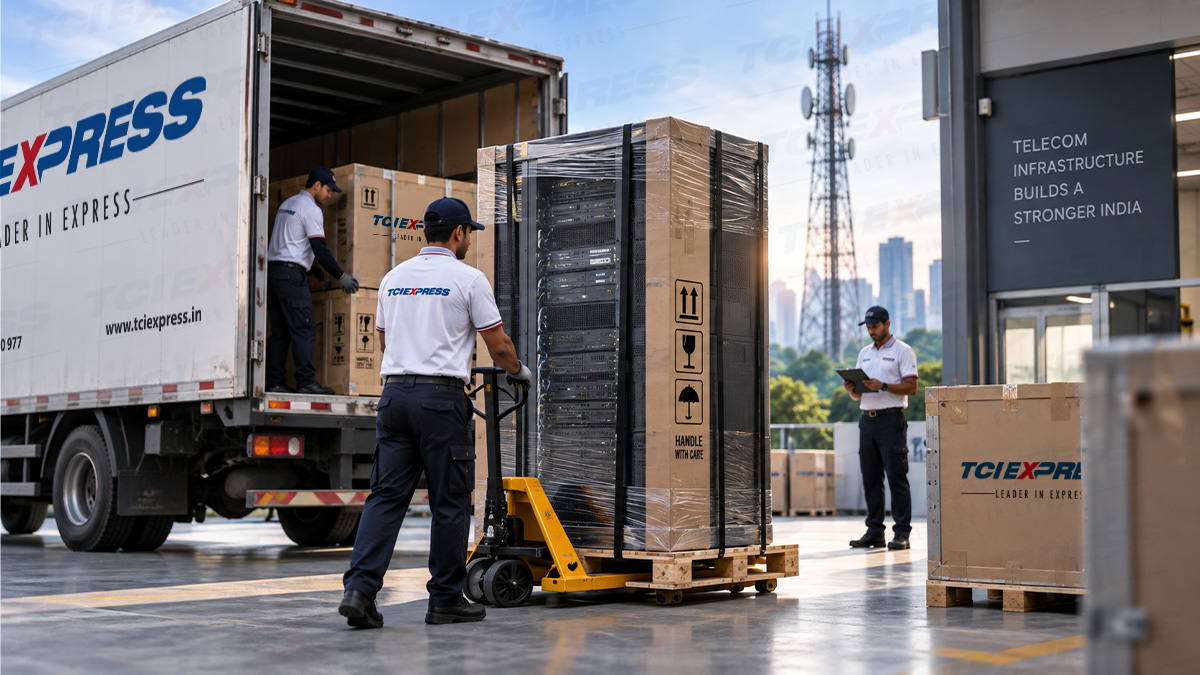
Secure Telecom Hardware and Server Rack Logistics in India
Key Takeaway / TL;DR
Learn how to plan secure transport for telecom electronics, cabinets and server racks using qualified packaging, custody controls, tracking and delivery readiness.
Telecom hardware logistics requires more than booking a vehicle for valuable equipment. Cabinets, racks, switches, radios, power units and packaged electronic assemblies must be correctly identified, protected, documented, secured and delivered to an authorised recipient. The transport plan should reflect the equipment's actual dimensions, weight, fragility, orientation, value and installation requirements.
No responsible logistics plan can promise that damage will never occur. A stronger objective is to reduce foreseeable risk through suitable packaging, accurate declarations, controlled custody, appropriate transport selection, visible milestones and a documented exception process.
Why is telecom hardware different from an ordinary parcel?
Telecom electronics may contain sensitive assemblies, connectors, screens, batteries or accessories. A large cabinet can also have a high centre of gravity and limited approved lifting points. Even when the external package looks strong, vibration, impact, moisture, dust, tilting or poor load distribution may affect the shipment.
The shipper or equipment owner should define:
- The exact equipment and model description
- Whether it can travel assembled or requires component separation
- Permitted orientation and stacking restrictions
- Approved lifting and handling points
- Acceptable environmental exposure
- Whether batteries, liquids, magnets or restricted components are present
- Packaging and inspection requirements
- Declared value and applicable risk-cover arrangements
The logistics team should not invent technical limits. Requirements must come from authorised product information, the manufacturer, the customer or a qualified technical team.
Start with a transport risk assessment
A practical risk assessment connects the equipment with the journey. It should consider pickup access, loading equipment, road conditions, planned transfers, expected weather, storage exposure, delivery access and unloading capability.
Ask these questions before booking:
- Is the final packed unit within the selected service's size and weight limits?
- Can the package tolerate the planned number of transfers?
- Are forklifts, pallet trucks, cranes or other equipment required?
- Can the origin and destination use that equipment safely?
- Does the site have a protected receiving and staging area?
- Are serial numbers, package IDs and accessories recorded?
- Who is authorised to release and receive the shipment?
- What happens if the seal, count or visible outer condition differs?
How should server racks and telecom cabinets be packaged?
Packaging should be engineered for the actual equipment and route. A thin carton that is sufficient for local movement may not be suitable for a heavy cabinet crossing several facilities. Likewise, wooden packaging alone is not proof of protection; the internal restraint, cushioning, moisture barrier and base design still matter.
A packaging plan may include:
- A stable pallet, skid or base compatible with the packed weight
- Internal restraint to prevent movement inside the enclosure
- Edge, corner and surface protection
- Suitable cushioning based on product sensitivity
- Moisture protection where exposure is foreseeable
- Tamper-evident seals or controlled closure where approved
- Orientation, centre-of-gravity and lifting labels
- A protected document pouch that does not cover handling labels
Package testing and technical approval should be performed by qualified parties. The transport provider may check visible shipment readiness but should not be treated as the equipment designer or technical certifier.
Measure and declare the final packed shipment
Quotations and vehicle planning depend on the final packed dimensions and actual weight. Protective bases, crates and palletisation can materially change both. Each unit should be measured after packaging, and the booking should identify whether the shipment can be stacked.
For multiple packages, create a package-level list showing:
- Unique package number
- Equipment or accessory description
- Serial number where the customer requires it
- Length, width, height and weight
- Declared value or invoice reference
- Seal number where applicable
- Required destination and receiving contact
Businesses can use the TCI EXPRESS freight estimate facility for initial planning where applicable. A sensitive or unusual shipment still requires a specific quotation and acceptance review.
Choose the service after defining the risk
Service selection should consider the complete journey rather than speed alone. Surface Express may support suitable planned cargo through the road network. Domestic Air Express may be evaluated when urgency justifies air movement and the cargo is accepted. Dedicated or larger movements may require another arrangement.
Compare:
- Commodity acceptance and package limitations
- Pickup and delivery access
- Number and nature of handling points
- End-to-end transit requirement
- Tracking and exception visibility
- Cost of packaging, transport, installation delay and replacement
- Insurance, liability and claims conditions
The cheapest freight rate may not provide the lowest total business risk. Equally, the fastest line-haul option may not help if the site is not ready to receive the equipment.
Control custody from pickup to authorised delivery
A clear custody record helps teams understand where the shipment was received, processed, transferred and delivered. The agreed procedure should define when package count, identity, seal and visible outer condition are recorded.
Useful milestones include:
- Booking and pickup confirmation
- Shipment collected
- Origin processing completed
- Dispatched or in transit
- Destination processing completed
- Out for delivery
- Delivered to the authorised recipient
- Electronic proof of delivery available
TCI EXPRESS provides a public shipment tracking facility and an electronic proof-of-delivery facility where applicable. Account-specific alerts, reporting or integration capabilities should be confirmed before onboarding.
TCI EXPRESS custody protocols for sensitive telecom hardware
When handling high-value telecom hardware, server racks, and network electronics, TCI EXPRESS applies strict chain-of-custody controls across every transit node. At origin pickup, operations staff conduct physical verification of outer packaging integrity, confirm unit counts against transport documentation, verify orientation and handling labels, and record unique tamper-evident seal serial numbers where applied. Identical verification checkpoints occur during hub consolidation, vehicle transshipment, and destination arrival before final delivery release.
Operational checks by the logistics team focus on observable outer packaging condition, secure vehicle stowage, and verifiable seal continuity. Internal hardware testing, circuit board diagnostic verification, and component functionality remain the technical responsibility of the customer or manufacturer quality team. For enterprise accounts managing critical telecom rollouts, TCI EXPRESS coordinates milestone status reporting via key account desks, automated exception notifications for schedule deviations, and digital proof-of-delivery (e-POD) capture with consignee confirmation upon handover.
Prepare documentation and security authority
The invoice, transport document, e-way bill, packing list and booking data should identify the same movement. If serial numbers or project references are required, define which system is authoritative. Restricted items must be declared accurately and accepted before dispatch.
The Government of India's e-Way Bill System provides official information about applicable electronic way-bill requirements. Tax treatment depends on the transaction, so the responsible business should obtain qualified advice rather than relying on a general logistics article.
Security instructions should name the people authorised to change the destination, open the package, approve a seal discrepancy or accept delivery. A phone call from an unknown person should not override the documented process.
What should happen when an exception is detected?
Common exceptions include a package-count difference, visible packaging damage, seal discrepancy, missing document, delayed connection, unavailable consignee or changed delivery instruction.
- Record the observed condition without making a technical conclusion.
- Protect the shipment from unauthorised movement or opening.
- Notify the approved logistics and customer contacts.
- Preserve scans, photographs or other agreed evidence.
- Obtain authority for delivery, holding, return or another action.
- Update the tracking or exception record.
- Close the case with the final authorised outcome.
Only an authorised technical or quality team should decide whether the equipment remains suitable for installation after an impact, moisture event or other concern.
How TCI EXPRESS supports telecom logistics
The official TCI EXPRESS Telecom page describes customised consignment movement through a network of more than 50,000 pickup and 60,000 delivery locations across India. Actual acceptance, capacity, delivery timing and handling conditions depend on the shipment and selected service.
Customers should first check the destination using the pin-code enquiry, then submit full requirements through the business enquiry facility or approved account channel.
Secure telecom shipment checklist
- Identify the equipment and every package accurately
- Obtain approved technical handling and packaging instructions
- Measure the final packed dimensions and weight
- Record value, serial numbers and accessories where required
- Confirm service acceptance and route suitability
- Verify loading, unloading and site access
- Align labels, invoices, e-way bills and booking data
- Name authorised release, escalation and receiving contacts
- Agree on custody milestones and evidence
- Define the response to a count, seal or condition exception
Final takeaway
Secure telecom hardware logistics is a chain of practical controls. Suitable packaging, accurate data, controlled custody and a ready recipient work together to reduce risk. Businesses should avoid absolute claims and instead build an evidence-based plan for the actual equipment, route and project consequence.

Frequently Asked Questions
Can server racks be transported fully assembled?
It depends on the equipment manufacturer's instructions, packed dimensions, internal restraint, centre of gravity, route, loading method and selected service. Obtain technical approval before booking.
Who is responsible for packaging telecom equipment?
The responsibility must be defined in the commercial agreement. Technical packaging specifications should come from the equipment owner, manufacturer or another qualified party.
Does shipment tracking prove that telecom equipment is undamaged?
No. Tracking records logistics events. Product acceptance or installation suitability must be determined by the authorised technical or quality team.
Is every pin code suitable for delivery of a large server rack?
No. Pin-code serviceability is an initial check. Package size, vehicle access, unloading capability, site hours and cargo acceptance must also be confirmed.