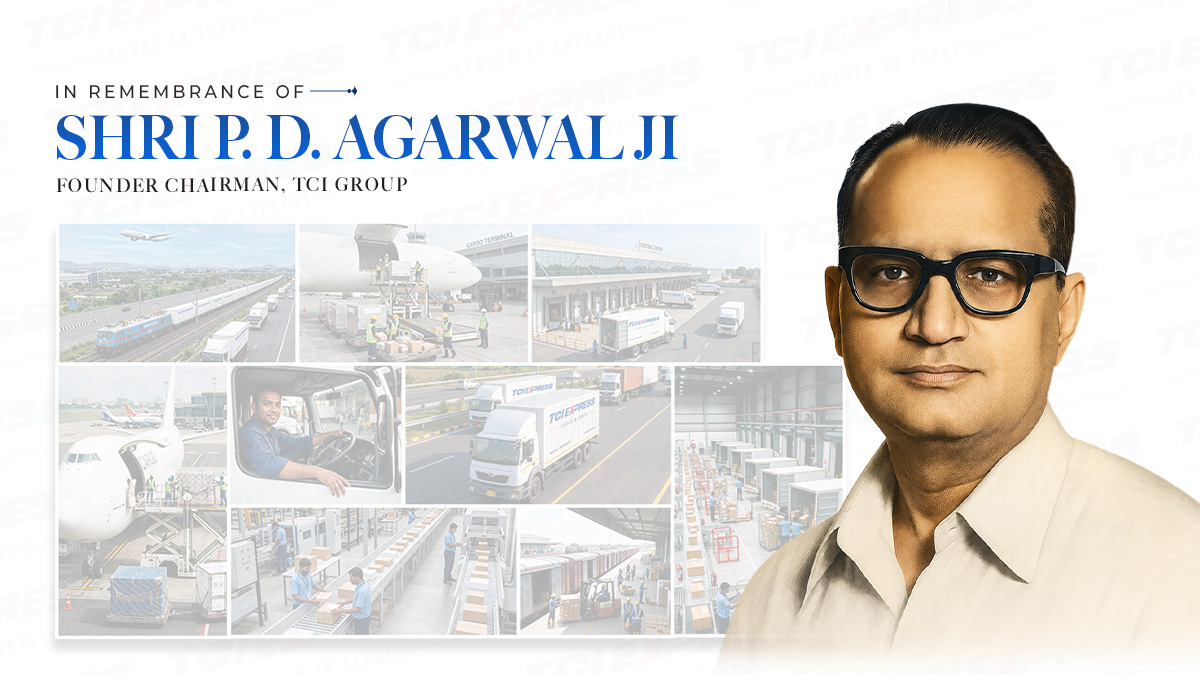
Remembering Shri P. D. Agarwal Ji: A Legacy of Trust That Keeps India Moving
Key Takeaway
- A Vision Rooted in Trust: In 1958, Shri P. D. Agarwal Ji ("PDji") founded Transport Corporation of India with one truck on the Calcutta–Bombay route, pioneering organized freight in India on personal accountability and unbreakable customer commitments.
- Honored Nationally by Department of Posts: Commemorating his birth centenary, the Government of India released a customized postage stamp and special cover celebrating his foundational contributions to national logistics connectivity.
- Values Beyond Commercial Enterprise: Deeply committed to the philosophy that business must serve society, instigating lasting initiatives across rural healthcare, driver welfare, education, and the nationwide annual Blood Donation Drive.
- Modern Stewardship under TCI EXPRESS: Carrying his legacy forward into 1,000+ branches, 5,500+ containerized vehicles, and automated sorting hubs—proving that while technology accelerates delivery, operational integrity is what earns lasting trust.
On 17 September, TCI EXPRESS remembers Shri Prabhu Dayal Agarwal Ji, Founder Chairman of TCI Group, on the anniversary of his passing. Born on 1 January 1920, Shri P. D. Agarwal Ji was a pioneering entrepreneur, philanthropist and transport-industry leader whose vision helped lay the foundation for an organised logistics network in India.
His story began with modest resources but a large sense of purpose. In 1958, he started Transport Corporation of India with one truck operating between Calcutta and Bombay. The journey that followed was built through persistence, personal responsibility and trust in long-term relationships.
Today, as TCI EXPRESS serves businesses through a wide network of express services, the founder's values remain relevant. Operational integrity, dependable service and customer trust are not only words used to describe the past. They are standards that must be demonstrated in everyday work, on every route and at every customer interaction.
From one truck to a larger national purpose
The official TCI Group birth-centenary account records that Shri P. D. Agarwal Ji founded TCI in 1958 with one truck travelling between Calcutta and Bombay. At that time, road transport was less organised, communication was slower and national supply networks did not have the digital systems and infrastructure available today.
Starting a transport enterprise in such an environment required more than commercial ambition. It required confidence that better organisation, accountability and service could connect businesses across long distances. Every shipment represented a promise to a customer, and every route helped build a relationship between producers, markets and communities.
The early beginning is often described through the phrase “one man, one truck, one office.” Its lasting meaning is not simply that the company started small. It shows that a large institution can begin with one person taking responsibility for one commitment and serving one customer well.
A pioneer who recognised the importance of logistics
Logistics supports the movement of raw materials, components, finished goods, medicines, machinery and everyday necessities. It connects factories with distributors, cities with smaller towns and businesses with new markets. Shri P. D. Agarwal Ji recognised the importance of this movement at a time when organised transport was still developing in India.
His contribution was not limited to operating vehicles. The larger task was to create confidence in the transport process. Customers needed to know that their goods would be accepted responsibly, moved with care and delivered through an accountable organisation.
That focus helped transport move from an informal transaction towards a structured business service. The current TCI Group journey traces the organisation's growth from its 1958 beginning into a diversified logistics enterprise. The scale has changed, but the core question remains familiar: can customers trust the organisation with an important business movement?
Trust as an operating principle
Official TCI material records Shri P. D. Agarwal Ji's belief that trust and complete commitment to customers were central to organisational success. Trust in logistics is created through repeated actions rather than a single statement.
It depends on practical behaviours:
- Accepting only commitments that can be responsibly assessed
- Providing accurate shipment and service information
- Handling goods according to agreed requirements
- Recording important custody and delivery events
- Communicating honestly when a journey changes
- Protecting customer information and commercial interests
- Taking ownership of problems and documenting their resolution
- Learning from exceptions instead of hiding them
These principles are as important in a digital supply chain as they were in the early days of road transport. Technology can make a status visible, automate sorting or improve route information. It cannot replace integrity in the decisions people make.
Operational integrity in everyday logistics
Operational integrity means that the physical shipment, booking data, documentation and customer commitment describe the same movement. It begins before pickup and continues through processing, main transit, destination handling and final delivery.
For the shipper, this means declaring the goods accurately, using suitable packaging, providing correct dimensions and weight, preparing the required documents and ensuring that the consignee is ready. For the logistics provider, it means evaluating the service requirement, recording custody events, communicating meaningful updates and following the agreed process when an exception occurs.
At TCI EXPRESS, this principle can be seen across the company's express-service portfolio. Surface, air, rail, international, e-commerce and dedicated movement options serve different business requirements. The right choice depends on the actual cargo, route, urgency, capacity, documentation and delivery outcome.
Integrity requires making that distinction clear. A broad network claim should not be treated as automatic acceptance for every shipment. A fast service should not be selected before checking the complete origin-to-destination plan. A tracking status should not be interpreted beyond what the recorded event confirms.
Service is measured through the complete journey
Customer service in logistics is not limited to answering a call. It includes the design and execution of the movement itself.
A dependable journey requires:
- Clear booking and pickup requirements
- Correct package identification and documentation
- A service selected for the cargo and lane
- Visible progress at meaningful milestones
- Named responsibility when an exception occurs
- Authorised delivery and appropriate proof of handover
- Post-delivery support for records, returns or claims where applicable
Customers can use the TCI EXPRESS pin-code enquiry for an initial destination check, the shipment tracking facility to view available status information and the electronic proof-of-delivery facility where applicable. These digital tools support access to information, while the shipment-specific terms determine the actual service commitment.
Customer trust must be renewed on every route
A long history can establish credibility, but it does not remove the need to earn trust again. Every new pickup, customer, branch, route and service interaction becomes part of the company's reputation.
For a growing business, logistics may affect production schedules, inventory availability, distributor relationships and customer commitments. When the shipment carries a replacement component or essential material, a delay can have consequences far beyond the freight charge. This is why customers value clear answers and responsible planning.
Trust grows when a provider:
- Understands the customer's real business requirement
- Explains what information is needed before booking
- Clarifies service availability and limitations
- Provides factual updates instead of vague assurance
- Escalates unusual cases through an accountable process
- Closes the movement with reliable records
This is how a founder's values become relevant to a modern organisation. They move from remembrance into daily decisions.
Building a connected India through movement
India's economic development depends on connections between manufacturing centres, agricultural regions, industrial clusters, ports, airports, warehouses, towns and customers. Logistics helps businesses participate in markets beyond their immediate location.
TCI's early Calcutta-Bombay route symbolised a connection between important commercial centres. Over time, the need for connection expanded. Businesses now expect road, rail, air and international options, digital status information, electronic documentation and support across a much wider distribution network.
TCI EXPRESS's infrastructure overview describes a hub-and-spoke model, containerised vehicles, GPS-enabled movement, secure hubs and automated sorting centres. These facilities and technologies reflect how the operating environment has changed since 1958.
Yet the purpose of infrastructure remains human and commercial. A sorting centre matters because it helps direct shipments towards their destinations. A branch matters because it connects customers with local operations. Tracking matters because people need to understand what has happened and what should happen next.
Progress must remain connected with responsibility
Growth creates a larger responsibility. More shipments, services and locations require stronger controls, better information and greater consistency. An organisation cannot rely only on the reputation created by earlier generations. It must protect that reputation through current conduct.
The TCI EXPRESS FY 2024–25 annual report describes corporate governance as part of the company's legacy and attributes to its founder a belief in integrity, transparency, stakeholder rights and long-term value creation. These ideas connect operational performance with wider responsibility.
Responsible progress includes:
- Maintaining transparent governance and ethical business conduct
- Investing in people, systems and operational improvement
- Using resources carefully and supporting sustainability
- Respecting employees, partners, customers and communities
- Creating value that can be sustained over time
This long-term view is especially important in logistics, where relationships often continue across years, locations and changing market conditions.
A legacy that extended beyond business
Shri P. D. Agarwal Ji is also remembered for philanthropy and service to society. The official TCI Group centenary account associates his wider contribution with education, health, village development and women's empowerment.
The TCI Foundation blood-donation programme describes his vision of improving access to blood support during critical situations. This legacy continues through community and healthcare initiatives, including the annual blood-donation activities held in his memory.
Business and social responsibility were not treated as unrelated ideas. The organisation's ability to grow created an opportunity to serve wider needs. Remembering this aspect of his life gives the anniversary greater meaning.
Leadership means creating opportunities for others
The TCI Group's centenary tribute opens with a reflection that organisations are built by people and that leaders create opportunities for people to grow. This idea remains relevant for employees across functions and generations.
A logistics network depends on drivers, branch teams, warehouse employees, customer-service representatives, technology professionals, sales teams, planners, finance teams, partners and leaders. Their roles differ, but their actions meet in the same customer outcome.
A strong legacy therefore encourages people to:
- Take responsibility for the work entrusted to them
- Respect colleagues and operating partners
- Share knowledge and develop the next generation
- Improve a process rather than accept a recurring problem
- Keep customer commitments visible in daily decisions
- Serve society with humility and practical action
How TCI EXPRESS carries the legacy forward
TCI EXPRESS carries this legacy forward by connecting the founder's principles with the requirements of modern B2B logistics. The tools are different today, but the standards remain recognisable.
- Integrity: aligning customer commitments with actual operating capability
- Service: planning the complete movement from pickup to authorised delivery
- Trust: communicating accurately and taking ownership of exceptions
- Progress: investing in networks, automation, technology and people
- Responsibility: contributing to communities and long-term stakeholder value
These principles should remain visible in routine work, not only in commemorative messages. The clearest tribute is an organisation that continues to act according to the values it honours.
A continuing guiding light: Leadership reflections on PDji's enduring ethos
Reflecting on the legacy of Founder Chairman Shri Prabhu Dayal Agarwal Ji (fondly remembered across the industry as "PDji"), TCI EXPRESS Managing Director Mr. Chander Agarwal and executive leadership emphasize that genuine institutional strength is anchored in values that transcend market cycles and technological eras. When PDji pioneered organised long-haul freight in 1958 with a single truck on the rugged Calcutta-to-Bombay corridor, he proved that transport is fundamentally an enterprise of trust—where every consignment represents a personal promise made to another business and community.
This enduring principle was formally commemorated during Shri P. D. Agarwal Ji's birth centenary, when the Department of Posts, Government of India, unveiled a customized commemorative postage stamp and special cover honoring his status as a visionary nation-builder who connected India's emerging industrial economy. As leadership highlighted during the centenary proceedings, PDji's operating doctrine rested on three immutable pillars: absolute integrity in customer commitments, empowering people at the grassroots, and treating corporate capability as a vehicle for societal good.
Today, as TCI EXPRESS drives modern logistics transformation—operating more than 5,500 containerised vehicles, high-throughput automated sorting centres at Gurugram and Pune, multimodal domestic air corridors, and over 1,000 nationwide branches—this founding philosophy remains the core compass. Modern tools such as automated dimension scanners and real-time digital proof of delivery (e-POD) enhance operational velocity, but leadership underscores that technology is solely an enabler: the true differentiator remains the personal accountability of drivers, branch teams, and operations specialists at every physical handover.
Equally vital is the living tradition of corporate citizenship championed by PDji. Under the stewardship of TCI Foundation and TCI EXPRESS, his commitment to community welfare continues to manifest in practical, compassionate action—from rural healthcare outreach and driver rehabilitation to the nationwide Shri P. D. Agarwal Blood Donation Drive conducted annually every September. For modern teams across the country, honoring the founder is not an annual retrospective; it is a daily standard of delivering trust across every mile.
Remembering with gratitude and purpose
Shri P. D. Agarwal Ji passed away on 17 September 1982, but the institution he founded continued to grow. His journey from one truck to a national logistics vision remains an example of what determination, integrity and customer trust can build over time.
On the anniversary of his passing, TCI EXPRESS remembers not only a founder but also the values that gave direction to the enterprise. His pioneering spirit helped shape a more organised approach to transport. His commitment to people and society broadened the meaning of leadership. His belief in trust continues to guide how relationships should be built and protected.
The most respectful way to carry a legacy forward is through responsible action. Every accurate commitment, carefully handled shipment, honest update and helpful response adds a new chapter to the values established at the beginning.
TCI EXPRESS pays tribute to Shri P. D. Agarwal Ji with gratitude and renews its commitment to operational integrity, service and customer trust across every route.
Key Takeaways from the Founder's Legacy:
- Start with Commitment: The "one man, one truck, one office" philosophy reminds us that great institutions are built by taking personal responsibility for one promise at a time.
- Integrity over Velocity: Enduring customer relationships are established through consistent, honest, and verifiable operational execution.
- Enterprise with Compassion: Business capability carries an inherent duty to uplift society, advance healthcare access, and support community well-being.
- People-Centred Growth: Real leadership lies in empowering teams, respecting operating partners, and creating meaningful opportunities for future generations.

Frequently Asked Questions
Who was Shri P. D. Agarwal Ji?
Shri Prabhu Dayal Agarwal Ji ("PDji") was the Founder Chairman of Transport Corporation of India. He was a pioneering entrepreneur, philanthropist and visionary leader of the Indian transport and logistics industry.
When was Shri P. D. Agarwal Ji born and when did he pass away?
He was born on 1 January 1920 and passed away on 17 September 1982. TCI EXPRESS and TCI Group commemorate his birth centenary and mark 17 September each year with nationwide community initiatives.
How did the Government of India commemorate Shri P. D. Agarwal Ji?
To mark his birth centenary, the Department of Posts, Government of India, released a Customized My Stamp and Special Cover in recognition of his pioneering contributions to Indian transport and nation-building.
When did Shri P. D. Agarwal Ji establish TCI?
He laid the foundation of Transport Corporation of India in 1958, beginning with one truck operating between Calcutta and Bombay under the guiding motto of "one man, one truck, one office".
What values define his legacy across TCI EXPRESS?
Official leadership reflections emphasize three core pillars: absolute integrity in customer commitments, empowering people at the grassroots, and treating business capability as a vehicle for community welfare.
How does TCI EXPRESS carry his legacy forward today?
TCI EXPRESS connects the founder's ethos with modern express logistics across 1,000+ branches, 5,500+ containerized vehicles, automated sorting hubs, and annual CSR programs like the Shri P. D. Agarwal Blood Donation Drive.